
Satellite Internet for Smartphones: How Connectivity Beyond Cities Will Change
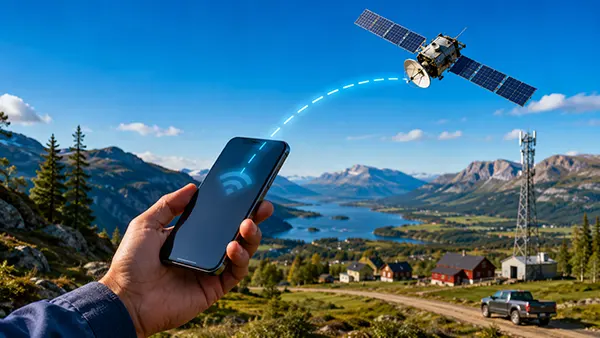
Satellite internet for smartphones is moving from experimental technology to a practical communication tool for people living or travelling beyond urban areas. By 2026, several telecom companies and satellite operators have already introduced direct-to-device services that allow ordinary smartphones to connect to satellites without specialised hardware. This development is changing how people communicate in rural regions, mountain areas, forests, offshore zones and places where traditional mobile towers are unavailable or unstable. The technology is particularly important for emergency communication, navigation, agriculture, logistics and tourism, where stable coverage has always been difficult to maintain.
How Satellite Connectivity for Smartphones Works in 2026
Modern satellite internet for smartphones differs significantly from earlier satellite communication systems that required large terminals or external antennas. New low Earth orbit satellite constellations operate much closer to the planet than traditional geostationary satellites. Because of this, signal delay is reduced and ordinary smartphones can maintain a more stable connection directly with orbiting satellites. Companies such as Starlink, AST SpaceMobile, Lynk Global and Iridium continue developing networks capable of supporting direct mobile communication.
One of the main changes in 2026 is the growing integration between mobile operators and satellite providers. Several telecommunications companies in Europe, North America and Asia now offer hybrid coverage systems. When a user leaves an area with traditional cellular coverage, the smartphone automatically attempts to connect to satellite infrastructure. In many cases, users do not need to manually activate this mode because modern devices handle the transition automatically.
Current satellite smartphone communication still has limitations compared to fibre or 5G networks in large cities. Data speeds remain lower, especially in remote regions with difficult terrain or bad weather conditions. However, for messaging, navigation, emergency calls, location sharing and lightweight internet browsing, the technology already provides practical benefits. Engineers are also improving antenna design inside smartphones, making satellite support more efficient without increasing device size.
Which Smartphones Already Support Satellite Communication
By 2026, satellite communication is no longer restricted to premium niche devices. Apple, Samsung, Google and several Chinese smartphone manufacturers have expanded satellite connectivity support in flagship and upper mid-range models. Apple continues improving Emergency SOS via satellite, while Android manufacturers increasingly support two-way messaging and limited internet access through satellite systems.
Many modern smartphones now include specialised modem chips capable of recognising both terrestrial and satellite signals. Qualcomm and MediaTek have invested heavily in hybrid communication technologies, allowing manufacturers to implement satellite functionality without dramatically affecting battery life. Devices launched in 2025 and 2026 increasingly advertise satellite support as a core safety and travel feature.
Compatibility still depends on regional agreements between operators and satellite companies. Some services remain limited to emergency communication, while others provide basic internet access or text messaging subscriptions. Coverage quality also varies depending on the satellite constellation available in the region. Rural users in Canada, Scandinavia, Australia and parts of Africa are currently among the groups seeing the biggest improvements from these systems.
How Rural Regions and Remote Industries Benefit
Satellite internet for smartphones is becoming especially important for people living outside major urban centres. Rural communities have traditionally faced slower internet speeds, unstable mobile reception and expensive infrastructure expansion. Building mobile towers across mountains, forests or sparsely populated farmland is often economically difficult for operators. Satellite communication reduces some of these barriers because coverage comes directly from orbit rather than ground infrastructure alone.
Farmers are increasingly using smartphones connected to satellite systems for precision agriculture tools, weather monitoring and machinery tracking. In remote agricultural zones, access to stable communication helps coordinate deliveries, equipment maintenance and field operations more effectively. Satellite connectivity also supports environmental monitoring and wildfire reporting in isolated regions.
Transport and logistics sectors are also adapting to this technology. Truck drivers, railway workers, shipping crews and field engineers often travel through areas with weak or non-existent mobile coverage. Satellite-enabled smartphones allow them to maintain communication, send coordinates and access operational updates without relying entirely on traditional networks. This improves both worker safety and logistical efficiency.
Emergency Communication and Safety Improvements
One of the strongest advantages of satellite smartphone connectivity is emergency reliability. Natural disasters frequently damage mobile towers and terrestrial infrastructure, leaving affected populations without communication. Satellite systems provide an additional communication layer that can remain operational even during floods, earthquakes, storms or large-scale fires.
Search and rescue operations increasingly depend on direct satellite communication from smartphones. Hikers, climbers, sailors and travellers in isolated areas can send emergency coordinates even without conventional network access. Rescue organisations in several countries now actively recommend smartphones with satellite support for outdoor travel and expedition activities.
Governments and emergency agencies are also integrating satellite communication into public warning systems. Some countries already test emergency alerts transmitted directly through satellite networks to compatible smartphones. This capability may become particularly important in regions vulnerable to natural disasters or with underdeveloped terrestrial communication infrastructure.

The Future of Satellite Internet on Mobile Devices
The satellite communication market for smartphones is expected to grow rapidly throughout the second half of the decade. Analysts forecast increasing competition between satellite operators as demand rises for global connectivity services. Lower launch costs and reusable rockets continue reducing expenses associated with satellite deployment, making large-scale constellations more commercially viable.
In the near future, satellite connectivity will likely become part of standard mobile subscriptions rather than an expensive premium service. Telecom companies are already experimenting with flexible pricing models that combine terrestrial and satellite coverage under a single contract. Users may eventually move between 5G, 6G and satellite networks without noticing technical differences during normal use.
Despite the progress, technical and regulatory challenges remain. Satellite bandwidth is still limited compared to urban fibre networks, and governments continue debating spectrum allocation rules and international coordination standards. Battery consumption, device heating and weather interference also remain engineering concerns. Even so, by 2026 satellite internet for smartphones has already shifted from a specialised backup option to an increasingly realistic communication standard for remote connectivity.
What Users Should Expect Over the Next Few Years
Consumers should expect gradual improvements rather than an instant replacement of traditional mobile infrastructure. Satellite communication is unlikely to fully replace terrestrial mobile towers in densely populated cities where fibre and advanced mobile networks remain faster and more cost-effective. Instead, the technology is developing as a complementary layer that fills coverage gaps and improves communication reliability.
Smartphone manufacturers will continue refining internal antennas, battery optimisation and signal processing systems. Future devices may support faster satellite data transfer, improved voice communication and broader compatibility with international satellite providers. Some manufacturers are also working on reducing the power required for satellite communication sessions.
For ordinary users, the biggest practical change may simply be the ability to remain connected in places that previously had no reliable signal at all. Travellers, remote workers, emergency responders and rural residents are likely to become the main beneficiaries of this transformation. As satellite infrastructure expands throughout 2026 and beyond, communication outside cities may become significantly more stable and accessible than it was only a few years ago.
Popular articles
-
 Miniature Nuclear Batteries: Can Radioisot...
A battery that keeps working for twenty, fifty or even hundreds of …
Learn more -
 Fusion Reactors with High-Temperature Supe...
Fusion energy has spent decades moving between impressive laboratory results and the …
Learn more -
 Spatial Casinos: How Mixed Reality and vis...
Casino interfaces are moving beyond flat screens. In 2026, spatial computing offers …
Learn more