
Recycling Lithium and Critical Metals: How Europe’s Supply Chain Is Changing in 2026
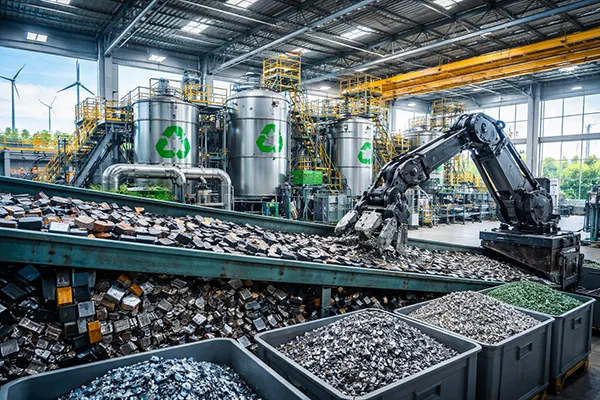
In 2026, Europe’s approach to lithium and critical metals is no longer theoretical policy — it is industrial reality. The rapid growth of electric vehicles, grid-scale storage and renewable energy systems has forced the European Union to rethink its dependence on imported raw materials. Lithium, nickel, cobalt, manganese and rare earth elements have become strategic assets. As a result, recycling is shifting from a peripheral activity to a central pillar of Europe’s industrial strategy. The transformation is visible in new legislation, large-scale recycling facilities and long-term supply contracts linking manufacturers with recyclers. The supply chain is becoming shorter, more transparent and increasingly circular.
Strategic Autonomy and the Impact of the Critical Raw Materials Act
The turning point came with the EU Critical Raw Materials Act, adopted in 2024 and actively implemented by 2026. The regulation sets clear benchmarks: by 2030, at least 10% of annual EU consumption of strategic raw materials should come from domestic extraction, 40% from processing within the EU, and 25% from recycling. These targets are not symbolic; they are reshaping investment flows and industrial planning across member states.
For lithium specifically, the pressure is significant. Demand for battery-grade lithium carbonate and hydroxide in Europe has more than tripled since 2020, largely due to electric vehicle production. While new mining projects are progressing in Portugal, Spain and Finland, recycling is viewed as the fastest way to stabilise supply. End-of-life batteries from first-generation EVs are now entering the waste stream in measurable volumes, creating a viable feedstock base.
The Act also restricts excessive reliance on a single third country for strategic materials. In practice, this has accelerated diversification away from China-dominated refining and processing. European refiners and recyclers are forming integrated partnerships, ensuring that recovered lithium and nickel re-enter local battery production rather than being exported for processing abroad.
From Waste to Resource: Industrial-Scale Battery Recycling
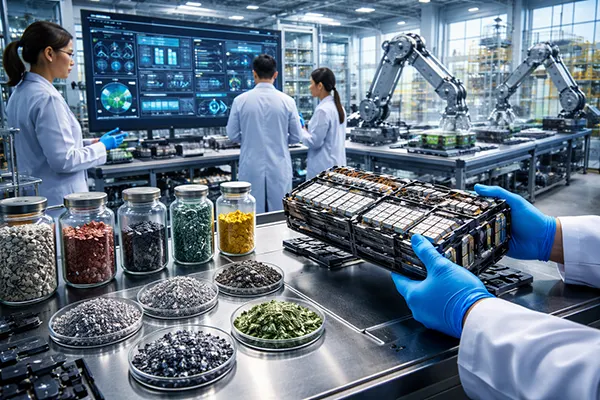
By 2026, Europe hosts several large hydrometallurgical recycling plants capable of recovering up to 95% of lithium, nickel and cobalt from used lithium-ion batteries. Companies such as Umicore in Belgium, Northvolt in Sweden and BASF in Germany have expanded closed-loop systems that connect battery manufacturing scrap directly to recycling lines.
Hydrometallurgy has become the dominant method because it allows selective metal recovery with lower energy intensity compared to traditional pyrometallurgical smelting. The recovered materials meet battery-grade purity standards, meaning they can be fed directly back into cathode production. This significantly reduces the need for imported primary raw materials.
Equally important is logistics. EU regulations now require systematic collection of industrial and automotive batteries, and digital battery passports — mandatory under the 2023 EU Battery Regulation — track composition and origin. This improves traceability and makes recycling operations more predictable and economically viable.
Reshaping the Supply Chain: Localisation and Vertical Integration
The European battery ecosystem is becoming increasingly vertically integrated. Automotive manufacturers are no longer passive buyers of raw materials; they are investing directly in recycling facilities and long-term offtake agreements. This reduces exposure to price volatility in global commodity markets, particularly for lithium and nickel.
Germany, France and the Nordic countries are leading this shift. Gigafactories are being built alongside recycling units, forming regional clusters. Production scrap from cell manufacturing — which can amount to 5–10% of total output — is immediately recycled on-site. This improves material efficiency and lowers carbon intensity.
Localisation also reduces geopolitical risk. In 2022–2023, supply chain disruptions highlighted Europe’s vulnerability to external shocks. By 2026, policymakers are prioritising shorter supply routes, encouraging investment through state aid frameworks and the Innovation Fund. Recycling is recognised not only as an environmental measure but as industrial security policy.
Economic and Environmental Implications
Recycled lithium typically has a lower carbon footprint than primary lithium extracted from hard rock or brine. According to data published by European battery producers, lifecycle emissions can be reduced by up to 50% when secondary materials are used in cathode production. This is increasingly important as automakers compete on sustainability metrics.
Cost competitiveness is improving as well. While recycling was previously dependent on high cobalt prices to remain profitable, advances in lithium recovery have strengthened its economic case even as battery chemistries shift toward lower cobalt content. Lithium iron phosphate (LFP) batteries, increasingly common in entry-level EVs, are now part of recycling streams.
Moreover, circular supply chains create skilled employment in chemical processing, engineering and waste management. Several regions previously dependent on traditional heavy industry are repositioning themselves as centres for battery recycling and materials refinement, supporting economic transition goals within the EU Green Deal framework.
Technological Innovation and Future Outlook
Innovation remains central to Europe’s ambitions. Direct recycling techniques — which aim to preserve cathode structure rather than breaking materials down into individual metals — are under active development. If scaled successfully, these methods could further reduce energy use and chemical consumption.
Research institutions and industry consortia are collaborating under programmes such as Horizon Europe. The focus extends beyond lithium-ion batteries to sodium-ion and solid-state technologies, ensuring that future recycling infrastructure can adapt to evolving chemistries rather than becoming obsolete.
Another emerging trend is urban mining. Instead of focusing solely on end-of-life EV batteries, companies are recovering critical metals from electronics, wind turbine magnets and industrial equipment. This broadens the raw material base and reinforces supply resilience.
What 2026 Signals for the Next Decade
By 2026, Europe has moved from strategy documents to operational capacity. Recycling is no longer treated as supplementary to mining; it is considered a structural component of the supply chain. While imported raw materials remain essential, their relative share is gradually decreasing.
The coming decade will likely bring tighter recycling targets, improved collection systems and further integration between battery producers and recyclers. The EU’s 2030 benchmarks are already influencing procurement decisions and factory design choices made today.
Ultimately, the shift towards circularity is redefining competitiveness. Europe may not match the scale of global mining giants, but by controlling processing and recycling within its borders, it is building a more stable and transparent supply chain for lithium and other critical metals — one designed to support electrification, energy security and climate neutrality.
Popular articles
-
 Digital Twins of Cities and Factories: How...
Digital twins have moved from experimental engineering tools to practical systems used …
Learn more -
 AI in Medical Gadgets: How Laboratory Inno...
Artificial intelligence has gradually moved from experimental medical laboratories into everyday consumer …
Learn more -
Recycling Lithium and Critical Metals: How...
In 2026, Europe’s approach to lithium and critical metals is no longer …
Learn more