
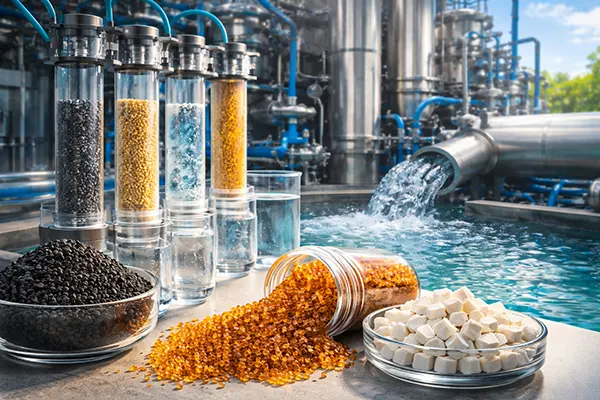
Next-Gen PFAS Water Filters: Sorbents and Practical Regeneration
PFAS in drinking water is no longer a niche issue: by 2026, monitoring and tighter limits are pushing utilities and industrial sites to upgrade treatment in ways that are measurable, auditable, and defensible. The hard part is not only removing PFAS from water, but also handling what happens next—because adsorption and ion exchange tend to concentrate PFAS into media, brines, or regenerant streams. This article focuses on the “new generation” angle: smarter sorbents, better selectivity for difficult compounds, and realistic regeneration pathways that reduce waste while keeping emissions under control.
What “2026-ready” PFAS treatment means in practice
In the EU, the recast Drinking Water Directive requires Member States to ensure drinking water complies with PFAS parametric values from 12 January 2026, which forces routine measurement and a clear compliance logic for exceedances. That alone changes how treatment is designed: you need steady performance, not just good short-term removal, and you need methods that cope with seasonal variability and mixed PFAS profiles.
In the United States, EPA’s PFAS National Primary Drinking Water Regulation (promulgated 26 April 2024) sets enforceable limits for PFOA and PFOS at 4 ng/L each, plus individual limits of 10 ng/L for PFHxS, PFNA, and HFPO-DA, and a mixture Hazard Index (HI) for PFHxS, PFNA, HFPO-DA and PFBS. The original schedule set initial monitoring by April 2027 and MCL compliance by April 2029, but by 2025 the EPA signalled it may revisit parts of the rule and extend timelines, so project teams in 2026 often plan to meet the stricter interpretation while keeping flexibility for regulatory changes.
“2026-ready” also means acknowledging a common failure mode: you can achieve low numbers early in a run, then drift upward as adsorption sites fill or as competing natural organic matter steals capacity. That is why modern designs lean on pilot testing, conservative bed-life assumptions, and operational indicators like breakthrough curves—rather than relying on marketing claims for a media type.
Regulatory targets drive technology choices
When limits move into single-digit ng/L territory, “good average removal” is not enough—especially for short-chain PFAS and highly mobile compounds. Treatment trains increasingly pair a robust primary barrier (often adsorption or ion exchange) with upstream optimisation: removing turbidity and dissolved organic carbon so the PFAS media spends its capacity on PFAS, not on everything else in the water.
The compliance mindset also changes sampling: you do not only test raw and finished water, you monitor mid-train points to learn whether the first vessel is approaching breakthrough, whether lead/lag configuration is behaving as expected, and whether a change in source water is shifting PFAS speciation toward harder-to-capture compounds.
Finally, targets force a waste strategy. If a project cannot explain what happens to spent carbon, resin, or regenerant, it is not a complete PFAS solution—because regulators and communities increasingly treat “captured but not managed” as unfinished work.
The core sorbents: GAC, ion exchange, and why selectivity matters
Granular activated carbon (GAC) remains a workhorse because it is operationally familiar, scalable, and strong on many long-chain PFAS (especially sulfonates). Its weakness is not that it “doesn’t work”; it is that bed life can collapse when water has high natural organic matter or when the PFAS mix shifts toward shorter-chain species. That is why GAC is often paired with pre-treatment, or used in lead/lag vessels so the second bed protects finished-water quality while the first bed does the heavy lifting.
Anion exchange (AIX) resins—particularly PFAS-selective formulations—often outperform GAC on shorter-chain PFAS and on mixed profiles, because electrostatic interactions can dominate where hydrophobic adsorption struggles. The trade-off is operational: some resins are sold as “single-use” media (replace and dispose), while others are designed to be regenerable, and the choice affects long-term cost, logistics, and environmental footprint.
A practical way to choose between GAC and AIX is to stop thinking in brand names and start thinking in mechanisms. Long-chain PFAS tend to be easier to capture by hydrophobic adsorption; short-chain PFAS often require stronger ionic interactions and tailored functional groups; and real waters contain competing anions that can reduce resin capacity. In 2026, the best designs usually come from pilots that compare media side-by-side using the site’s real water, not idealised lab matrices.
Emerging sorbents: faster kinetics, higher capacity, smarter chemistry
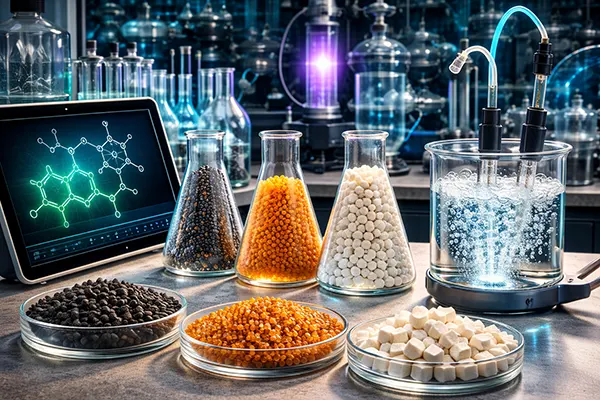
A new generation of PFAS sorbents targets three weak points of legacy media: slow mass transfer (kinetics), poor capture of short-chain PFAS, and difficult end-of-life handling. Research and early deployments point to materials engineered for rapid uptake and more predictable selectivity, including modified carbons, polymeric sorbents, and mineral-based adsorbents tuned for anionic fluorinated compounds.
One example reported in 2026 coverage is layered double hydroxide (LDH) materials designed to attract PFAS electrostatically and load them quickly, potentially reducing contact time requirements compared with conventional approaches. The value proposition here is not “magic removal”, but a more compact footprint and a more concentrated waste stream that can be routed to destruction methods more efficiently.
It is worth being blunt: many “new” sorbents look excellent in clean laboratory water, then lose their edge in real conditions. For 2026 procurement, the credible signals are independent pilot data, clear regeneration or disposal pathways, and transparent performance boundaries (what they capture well, what they do not, and what water quality ranges they tolerate).
Regeneration and end-of-life: reducing waste without shifting the problem
Regeneration is where PFAS treatment either becomes sustainable or turns into a revolving door of landfill and transport. With GAC, thermal reactivation is a long-standing practice, but PFAS introduces extra scrutiny: the goal is not just to restore adsorption capacity, but to ensure PFAS is destroyed or fully controlled in off-gas and residues. Recent work on thermal reactivation specifically for PFAS-laden GAC reflects that shift toward measuring destruction and emissions, not only “carbon is reusable again”.
For ion exchange, regeneration typically uses brines and solvents that strip PFAS from resin into a smaller liquid volume. That can be a win—if, and only if, the regenerant is then treated with a destruction technology. Otherwise you have simply moved PFAS from water into a concentrated waste liquid, which can be harder to handle than solid media in many jurisdictions.
In 2026, the honest framing is this: adsorption and ion exchange are separation steps. They buy you compliance in finished water, but they create a concentrated PFAS stream that must be managed through destruction, secure disposal, or a tightly controlled regeneration loop with verified outcomes.
Destruction pathways for concentrated PFAS streams
The destruction toolbox is expanding, but it is uneven in maturity. High-temperature processes (including specialised incineration and certain thermal treatment routes) are widely used because fluorinated chemistry is hard to break, yet they require careful control to avoid incomplete breakdown and to manage fluorinated by-products. When thermal routes are used for regenerated media or concentrates, operational safeguards and monitoring are part of the real cost.
Non-thermal and lower-temperature approaches—such as electrochemical oxidation, plasma-based treatment, and advanced reduction/oxidation schemes—are being pushed because they may offer on-site destruction for brines or concentrates, reducing transport and improving accountability. The practical question is always the same: can the process achieve deep defluorination in the site’s real matrix at a stable energy cost, and can it be verified by routine analytics?
For many projects, the best near-term approach is hybrid: use adsorption or AIX to capture PFAS reliably, regenerate where it is technically justified, and send the resulting concentrate to a destruction route that has measurable performance and transparent emissions control. That is less glamorous than a single “all-in-one” solution, but it matches how PFAS compliance is actually being delivered in 2026.
Popular articles
-
 Digital Twins of Cities and Factories: How...
Digital twins have moved from experimental engineering tools to practical systems used …
Learn more -
 AI in Medical Gadgets: How Laboratory Inno...
Artificial intelligence has gradually moved from experimental medical laboratories into everyday consumer …
Learn more -
 Recycling Lithium and Critical Metals: How...
In 2026, Europe’s approach to lithium and critical metals is no longer …
Learn more