
Spatial Casinos: How Mixed Reality and visionOS 27 Could Bring Tables and Slots into the Room
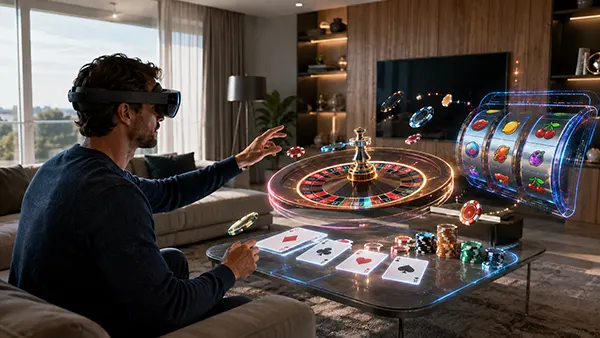
Casino interfaces are moving beyond flat screens. In 2026, spatial computing offers a broader idea than a conventional “VR casino”: digital games can appear inside the user’s real room, with virtual tables, cards and controls placed around physical furniture.
How visionOS 27 Could Change Casino Interfaces
Apple’s visionOS 27 preview improves object tracking so apps can follow physical items as they move. A real table could become the fixed surface for a virtual roulette wheel, betting layout or card game without replacing the room with an artificial scene.
Today, casino websites still rely mainly on familiar screen-based navigation, with games organised into clear categories and opened in a browser. NolimitWay, for example, presents sections for slots, roulette, blackjack, poker and live casino in this conventional format. Spatial computing could eventually extend the same familiar structure into the room, allowing players to interact with tables, cards and game controls as three-dimensional elements rather than flat interface components.
visionOS 27 also adds support for 3D Gaussian Splats in RealityKit, which can reproduce scanned objects and places in strong visual detail. In casino design, this could help create more convincing table surfaces, dealer areas or room-scale scenes.
Hands, Eyes and Spatial Sound
Vision Pro accepts input from hands, eyes and voice. A player could look towards a card or control and confirm an action with a gesture, while chips and menus remain within comfortable reach.
Eye input needs careful handling because visionOS limits access to gaze information. Interfaces can react to focus without giving an app unrestricted raw eye-tracking data, while other sensitive input remains permission-controlled.
Spatial audio can make a dealer’s voice, roulette ball or table sounds seem to come from a believable direction. visionOS 27 can also model how sound behaves around materials, helping scenes feel more coherent.
What a Spatial Casino Might Look Like
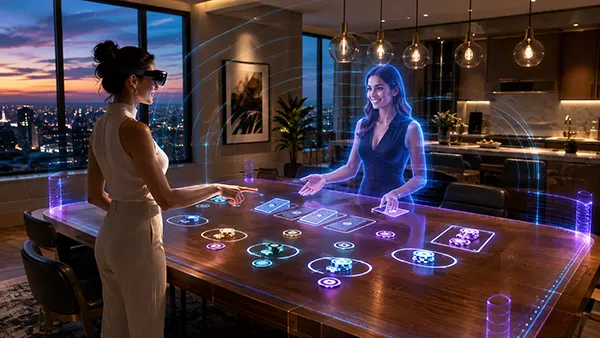
A mixed-reality roulette game could place a wheel on a dining table and keep the betting area beside it. Blackjack could use floating cards above the same surface, while a live dealer feed might appear behind the virtual table.
Developers can work with Unity and Godot, while supported spatial accessories include PlayStation VR2 Sense controllers and Logitech Muse. This gives designers options beyond hand gestures alone.
These capabilities do not mean visionOS 27 contains a ready-made spatial casino. They are development tools. Real-money services would still need licensing, age checks, secure payments and compliance with local gambling rules.
Comfort and Responsible Play Still Matter
Hardware sets limits. The current M5 Vision Pro weighs about 750–800 grams with fitted components, and Apple rates its battery for up to 2.5 hours of general use. Long sessions may be less convenient than using a phone or laptop.
Mixed reality also makes responsible design important. When tables, sounds and prompts occupy the room, spending and session information should stay visible. Deposit limits, time reminders and a clear exit should not be hidden by visual effects.
The near-term direction is more likely to be an optional spatial layer than a replacement for ordinary casino interfaces. visionOS 27 can make positioning, interaction and audio more convincing, but adoption will still depend on comfort, regulation, cost and demand.
Popular articles
-
 Miniature Nuclear Batteries: Can Radioisot...
A battery that keeps working for twenty, fifty or even hundreds of …
Learn more -
 Fusion Reactors with High-Temperature Supe...
Fusion energy has spent decades moving between impressive laboratory results and the …
Learn more -
Spatial Casinos: How Mixed Reality and vis...
Casino interfaces are moving beyond flat screens. In 2026, spatial computing offers …
Learn more