
Robots in Hospitals 2026: Where They Truly Support Medical Staff
Hospitals in 2026 rely on robotic systems not as experimental tools, but as part of everyday clinical practice. Their role is clearly defined: reduce routine workload, increase precision, and support medical teams in high-pressure environments. Rather than replacing professionals, robots now handle repetitive, time-consuming, and technically demanding tasks, allowing doctors and nurses to focus on patient care and complex decision-making.
Clinical Robotics in Surgery and Patient Care
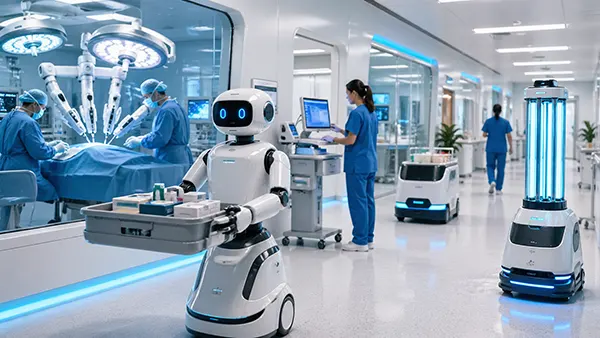
Robotic-assisted surgery has become routine in many hospitals, particularly in disciplines such as urology, cardiology, and minimally invasive general surgery. Systems like da Vinci allow surgeons to operate with enhanced precision, using high-definition 3D imaging and articulated instruments. This approach reduces tissue damage, shortens recovery time, and improves overall surgical outcomes.
Beyond the operating theatre, robots assist with patient monitoring. Mobile units equipped with sensors can track vital signs, alert staff to abnormalities, and support remote observation. In busy wards, this reduces the need for constant manual checks and helps medical teams prioritise urgent cases.
Rehabilitation technologies also benefit from robotics. Devices designed for physical therapy guide patients through controlled movements, ensuring consistent repetition and measurable progress. These systems are particularly useful in post-stroke recovery and orthopaedic rehabilitation programmes.
Precision and Safety Improvements Through Robotics
One of the key advantages of hospital robotics is improved accuracy. Surgical systems eliminate hand tremors and allow movements at a microscopic scale. This leads to fewer complications and more predictable outcomes, especially in delicate procedures.
Robots also play a role in infection prevention. Automated disinfection units using ultraviolet light are widely deployed to sterilise patient rooms and operating spaces. This reduces the risk of hospital-acquired infections, which remains a major concern in healthcare systems.
Modern robotic systems are equipped with safety protocols, including real-time monitoring and automatic shutdown mechanisms in case of malfunction. These features ensure that human oversight remains central, while technology adds an additional layer of protection.
Logistics and Operational Efficiency Inside Hospitals
Hospital logistics has changed significantly with the introduction of autonomous robots. These machines transport medications, laboratory samples, and equipment between departments, navigating corridors independently using sensors and mapping systems.
This automation reduces delays and minimises the need for manual transport by staff. In large medical centres, where distances can be considerable, robots ensure faster delivery and more predictable workflows. As a result, healthcare professionals spend less time on non-clinical tasks.
Pharmacy departments also rely on robotics for dispensing medication. Automated systems prepare doses with high accuracy, reducing the likelihood of human error. This is particularly important in critical care settings where precision is essential.
Cost, Workflow, and Staff Impact
The financial aspect of robotics is often discussed in terms of long-term efficiency. Although initial investment is high, hospitals benefit from reduced errors, improved workflow, and better use of staff resources. Over time, these factors contribute to operational savings.
Workforce roles are evolving rather than disappearing. Medical staff are increasingly trained to work alongside robotic systems, focusing on supervision, interpretation of data, and patient interaction. Routine manual tasks are gradually reduced.
Successful implementation depends on integration with existing hospital systems. Robotics must work seamlessly with digital records, scheduling tools, and communication platforms. Without proper integration, the advantages of automation are limited.

AI Integration and Decision Support Systems
Robotics in healthcare is closely connected with artificial intelligence. Many systems now analyse data in real time, supporting clinical decisions. For example, imaging tools can highlight potential abnormalities, helping radiologists identify issues more efficiently.
In intensive care, monitoring systems track patient data continuously and provide early warnings of deterioration. This predictive capability allows medical teams to intervene sooner, reducing the risk of complications.
Telepresence robots enable remote consultations, allowing specialists to assess patients without being physically present. This improves access to expertise, particularly in smaller or rural hospitals.
Ethical and Practical Considerations in 2026
Despite the advantages, robotics raises important ethical questions. Data protection is a primary concern, as these systems handle sensitive medical information. Hospitals must ensure compliance with strict regulations and maintain secure data storage.
Another challenge is preserving human interaction in healthcare. While robots improve efficiency, patient trust still depends on communication with medical professionals. Technology must support, not replace, this relationship.
Responsibility and accountability remain clearly defined. In all critical decisions, the final authority lies with healthcare professionals. Robotics serves as a support system, enhancing capabilities without removing human judgement.
Popular articles
-
 Fusion Reactors with High-Temperature Supe...
Fusion energy has spent decades moving between impressive laboratory results and the …
Learn more -
 Spatial Casinos: How Mixed Reality and vis...
Casino interfaces are moving beyond flat screens. In 2026, spatial computing offers …
Learn more -
 What Technologies Were Used to Create the ...
Slot machines, or ‘one-armed bandits’ as they were once known, have come …
Learn more