

Holographic Displays: Where the Technology Is Moving Beyond Prototypes into Real-World Use
For decades, holographic displays were associated mainly with science fiction, trade-show demonstrations, and laboratory research. By 2026, however, several forms of holographic and holographic-like visualisation have begun moving into practical environments. Advances in optics, computational imaging, artificial intelligence, and display engineering have allowed organisations to use three-dimensional visual content in medicine, industrial design, education, defence, retail, and business communication. While fully interactive free-floating holograms remain limited, commercially available systems are already delivering measurable benefits in sectors where spatial understanding is critical.
Healthcare and Medical Visualisation Are Leading Adoption
Healthcare has become one of the most practical environments for holographic display technology. Surgeons increasingly use three-dimensional visualisation systems to study complex anatomical structures before procedures. Instead of analysing multiple two-dimensional scans, specialists can examine organs, blood vessels, and skeletal structures from different angles within a holographic environment.
Hospitals and medical research centres in Europe, North America, and Asia have invested in advanced visualisation solutions that convert MRI and CT data into interactive three-dimensional models. This approach helps improve surgical planning, supports medical education, and allows physicians to explain procedures more clearly to patients and their families.
The growing availability of powerful graphics processors and cloud-based rendering systems has also reduced deployment costs. Medical institutions no longer require specialised research facilities to benefit from advanced visualisation. As a result, holographic imaging is becoming a practical clinical tool rather than an experimental technology.
How Medical Teams Benefit from Spatial Imaging
One of the most significant advantages is improved depth perception. Traditional displays often require specialists to mentally reconstruct three-dimensional structures from multiple images. Holographic visualisation reduces this cognitive burden by presenting information in a more intuitive format.
Medical training programmes have also adopted holographic anatomy models. Students can explore highly detailed representations of organs, muscles, and vascular systems without relying exclusively on physical specimens. This creates additional learning opportunities while preserving accuracy.
Another benefit is collaboration. Multiple healthcare professionals can review the same three-dimensional model simultaneously, discuss treatment strategies, and identify potential complications before a procedure takes place. This supports better decision-making in complex medical cases.
Industry, Engineering and Manufacturing Are Expanding Use Cases
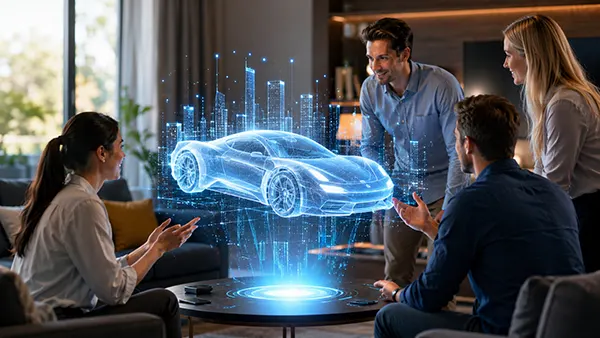
Manufacturing companies have emerged as major adopters of advanced holographic displays. Engineers working on aircraft, automotive systems, industrial machinery, and robotics increasingly use three-dimensional visualisation to inspect designs before physical production begins.
Modern engineering projects often involve thousands of interconnected components. Holographic visualisation enables teams to evaluate spatial relationships, identify design conflicts, and test assembly processes in a virtual environment. This can reduce development time and minimise costly production errors.
Large manufacturers are also integrating holographic technologies into digital twin systems. These virtual representations of physical assets allow engineers to monitor equipment performance, simulate maintenance procedures, and analyse operational data in a more intuitive format.
Why Engineering Teams Are Investing in Holographic Systems
One reason is efficiency. Traditional computer-aided design software remains essential, but complex projects often benefit from immersive visualisation that provides a more realistic understanding of size, shape, and spatial arrangement.
Another factor is collaboration across global teams. Engineers located in different countries can interact with the same three-dimensional model during meetings. This reduces misunderstandings and improves communication between design, manufacturing, and quality-control departments.
Safety training has become another practical application. Industrial workers can practise maintenance procedures, equipment inspections, and emergency responses using detailed holographic representations before working with actual machinery. This helps reduce operational risks and training costs.
Business Communication, Retail and Education Are Creating New Opportunities
Beyond healthcare and industry, holographic displays are gradually finding commercial applications in public-facing environments. Retailers have experimented with three-dimensional product presentations that allow customers to examine items from multiple perspectives without requiring physical inventory on display.
Educational institutions are also exploring new teaching methods. Complex subjects such as physics, chemistry, engineering, archaeology, and astronomy often involve structures that are difficult to understand through flat images alone. Holographic visualisation can make these concepts easier to explain and remember.
Corporate communication is another area experiencing growth. Organisations increasingly use advanced three-dimensional presentation systems during conferences, exhibitions, and executive meetings. These displays help communicate technical information more effectively while supporting remote collaboration.
The Challenges That Still Limit Widespread Deployment
Despite significant progress, several barriers remain. High-end holographic systems often require specialised hardware, advanced computational resources, and carefully controlled viewing conditions. These factors continue to influence deployment costs.
Content creation also presents challenges. Producing high-quality holographic experiences requires specialised software, skilled designers, and large volumes of visual data. Many organisations are still developing the expertise needed to create effective holographic content.
Nevertheless, the direction of the industry is clear. As display components become more affordable and computing power continues to increase, holographic visualisation is expected to become more accessible. By 2026, the technology has already moved beyond the prototype stage in several sectors, demonstrating practical value where three-dimensional understanding improves decision-making, training, communication, and operational efficiency.
Popular articles
-
 Miniature Nuclear Batteries: Can Radioisot...
A battery that keeps working for twenty, fifty or even hundreds of …
Learn more -
 Fusion Reactors with High-Temperature Supe...
Fusion energy has spent decades moving between impressive laboratory results and the …
Learn more -
 Spatial Casinos: How Mixed Reality and vis...
Casino interfaces are moving beyond flat screens. In 2026, spatial computing offers …
Learn more